Offline mode, showing a cached version.

17
US0096002 Rolling Thunder
Trine University
Prototype
P
Internal Combustion Engine
ICE
Gasoline
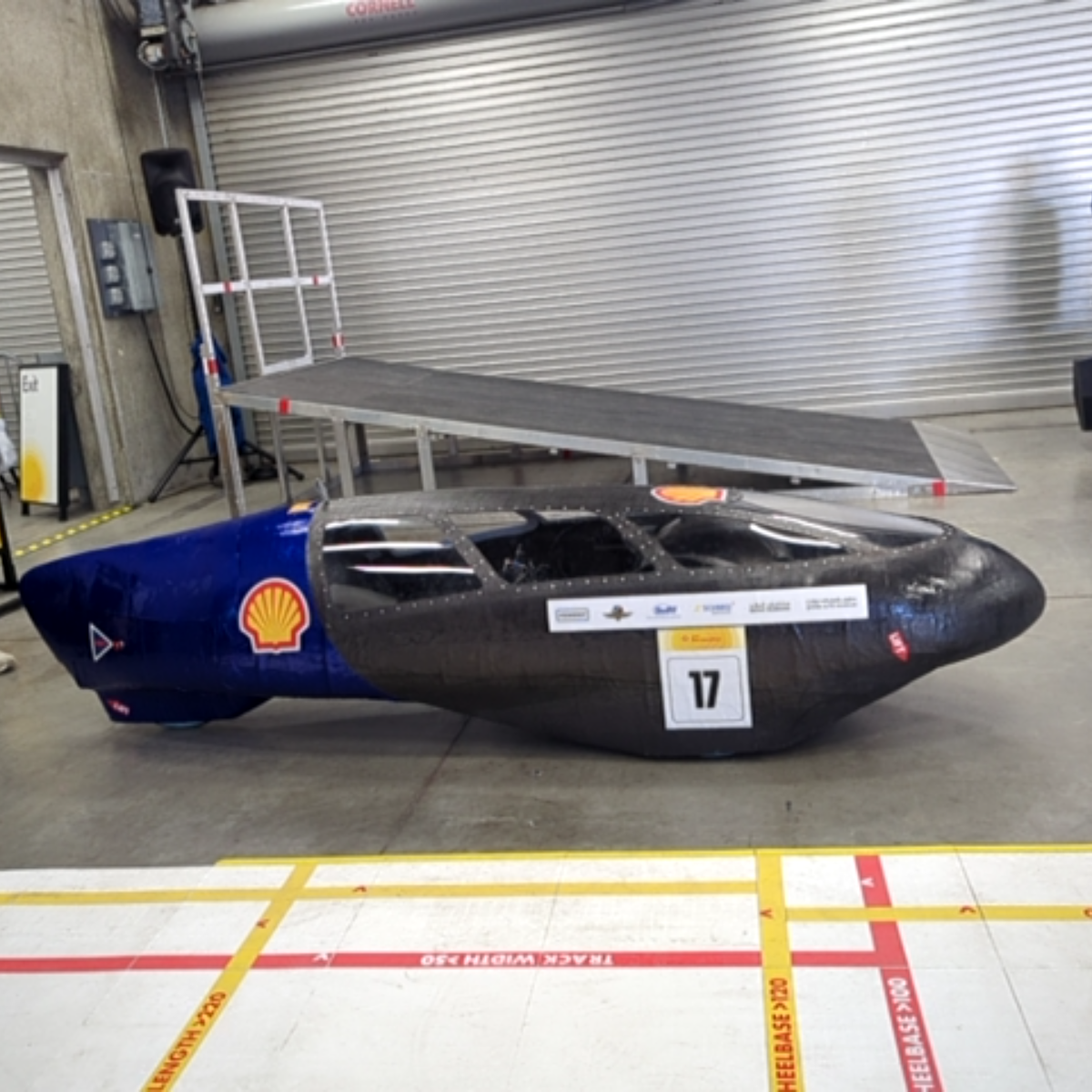
Technical Inspections
Before they get on track, Prototype vehicles need to pass a series of 10 technical inspections. For some, the only goal is getting through this test. Many never even make it that far.
10/10
Complete
Complete
Passed
1. Telemetry
3 / 3
Joulemeter issued to team?
Liquid Flowmeter issued to team?
Voltagemeter issued to team?
Passed
2. Inspection Queue Entry
4 / 4
SHELL logo front, Race number, Partner sticker / both sides
(4 a-c)
Lift here arrow stickers
(26 f)
Opening mechanism stickers
(30 c)
Other stickers < 400 cm²
(4 d)
Passed
3. Driver's Control
26 / 26
Appropriate motorsports helmet - Primary Driver
(21 a-g)
Three-quarter helmet - Primary Driver
(21 b)
Helmet label readable - Primary Driver
(21 c)
Helmet has no cracks/indentations - Primary Driver
(21 c)
Visor is clear and has no cracks - Primary Driver
(21 d)
Single piece fire retardant racing suit (s) - Primary Driver
(22 a)
Fire retardant gloves - Primary Driver
(22 c)
Flat, closed toe shoes - Primary Driver
(22 b)
Cotton socks, no bare skin visible - Primary Driver
(22 b, e)
FCR balaclava if used - Primary Driver
(22 d)
Driver weight (> 50kg) - Primary Driver
(20 a)
Appropriate motorsports helmet - Reserve Driver
(21 a-g)
Three-quarter helmet - Reserve Driver
(21 b)
Helmet label readable - Reserve Driver
(21 c)
Helmet has no cracks/indentations - Reserve Driver
(21 c)
Visor is clear and has no cracks - Reserve Driver
(21 d)
Single piece fire retardant racing suit (s) - Reserve Driver
(22 a)
Fire retardant gloves - Reserve Driver
(22 c)
Flat, closed toe shoes - Reserve Driver
(22 b)
Cotton socks, no bare skin visible - Reserve Driver
(22 b, e)
FCR balaclava if used - Reserve Driver
(22 d)
Driver weight (> 50kg) - Reserve Driver
(20 a)
Ballast required?
(20 b)
Ballast based on lightest driver
(20 b)
Ballast of suitable type, proper location, sealed
(20 b)
Number of ballast locations
(20 b)
Passed
4. Vehicle Dimensions
6 / 6
Height < 1000 mm
(39 a)
Width < 1300 mm
(39 e)
Length < 3500 mm
(39 f)
Track width > 500 mm
(39 b)
Wheelbase > 1000 mm
(39 d)
Maxi height 1.25 X track width
(39 c)
Passed
5. Brakes
8 / 8
Brake documentation
(67 c ii)
2 independently operated Hydraulic brake system 1 front & 1 rear
(43 a)
Brake pedal 1,000 mm², min width 30 mm
(43 a v)
Brake rotors point in direction of wheel rotation
(43 a)
No acting on tyres
(43 a)
All wheels have brakes
(43 a)
Ergonomy
(43 a)
Effectiveness Ramp Test - Dynamic
(43 b)
Passed
6. Driver Safety
26 / 26
Safety belt must be designed for motorsports use
(29 g)
Mounting points are clearly accessible for inspection
(29 e)
Safety Belts = 5 mounting points
(29 a)
Must have 5 independent belts attached to structure - chassis fixing
(29 a)
Crotch strap under body
(29 b)
Safety belt must be in straight line between mounting point and shoulder
(29 f)
Safety belt has a tight fit (no slack), length adjustor high enough for adjustment
(29 c)
No modifications of safety belt
(29 h)
Safety belt strength verified
(29 d)
Internal/ext'l opening mech effective/intuitive
(30 c)
Method of opening accurately marked with sticker
(30 c)
No adhesive tape to close driver compartment from outside
(30 d)
Roll bar resist 70 kg all directions
(26 d)
Roll bar 50 mm > driver's head - Primary Driver
(26 b)
Roll bar width > shoulders - Primary Driver
(26 c)
Roll bar 50 mm > driver's head - Reserve Driver
(26 b)
Roll bar width > shoulders - Reserve Driver
(26 c)
Driver exit < 10 seconds - Primary Driver
(30 a)
Driver exit < 10 seconds - Reserve Driver
(30 a)
Front vis 180° & Tint - driver must be seen - Primary Driver
(28 a)
Rear visibility - see cheat sheet - Primary Driver
(28 b)
Front vis 180° & Tint - driver must be seen - Reserve Driver
(28 a)
Rear visibility - see cheat sheet - Reserve Driver
(28 b)
Quality of body driver collision protection
(26 a-d)
Front Crumple Zone = 100 mm
(25 a ii)
Crumple space-protect from front/side impact
(25 a) ii, 26 a)
Passed
7. Mechanical Vehicle Design
20 / 20
Vehicle weight < 140 kg
(39 g)
Windows material (polycarbonate/Lexan)
(25 f)
Electrical automotive horn, sound level > 85 dBa @ 4 m
(31 a-c)
Fully closed body
(25 h, k)
Solid floor & frame
(25 j)
No external appendages or sharp edges
(25 c)
Body panels do not change shape in wind
(25 b, d)
Chain/belt guard (all rotating equipment)
(34 g)
Running wheels (Pr:3/4)
(25 a) i )
Rims compatible with the dimensions of the tyre
(41 a-b)
Wheel compliance
(41 a, 48 c)
Tyres are in good condition
(49 d)
Tyre valves are accessible
(49 f)
Bulkhead rigid & fire resistant
(27 b, d)
Bulkhead isolates energy/driver compartment
(27 a)
Wheels isolated from driver, chassis, or body
(41 c)
Nothing touching wheels (e.g. batt, wires, etc...)
(41 d)
Steering is efficient and has no play
(32 b)
If electric steering, demonstrate default safe state
(32 d)
Intuitive steering control
(32 b)
Passed
8. Electrical Vehicle Design
22 / 22
Correct vehicle electrical schematic
(67 c)
Charger built for battery
(57 d) iii)
Charging Protection (fire blanket, Lipo bag)
(24 j)
Capacity < 1000 Wh
(57 d) iv)
Max 60 V Peak
(57 a)
Only one Battery, 2 terminals, single physical package
(57 b) ii)
Solid metal containment tray OR Lipo bag
(57 d) vi)
Batt mount firm, behind b/head, not under seat
(57 c)
Main fuse < 300 mm from +ve terminal ADD fuse size
(57 e)
Main fuse is sized correctly for the system
(57 e)
Elec system has proper fuse protection
(57 g)
Drivers Display
(57 i)
Electrical enclosures - transparent
(57 j)
Electrical wiring connections visible/no splices
(57 k)
JM Installation in engine compartment
(56 c)
JM visible and accessible from outside
(56 b)
JM Correct circuit location
(56 c)
JM Counting Correctly
(56 c)
Internal Estop Switch
(37 g) i)
External Estop mounting location
(37 g) ii)
Latching External Estop push button (no push/pull levers)
(37 k)
Blue triangle sticker
(37 g) iii)
Passed
9. Energy Verification
36 / 36
1 Shell fuel tank 30/100/250 cc
(61 a)
Safety valve location (between reg and tank)
(60 d) i)
No valve(s) after the flowmeter
Safety valve tested at 5 bars Max (ALL inspectors MUST wear goggles!!)
(60 c) iv)
Translucent and rigid hoses
(61 f)
Fuel line internal diameter
Fuel pressure gauge visibile and easy to read
(60 c) iii)
Fuel tank vertical position
(61 b)
Fuel tank easy to refill (with burette)
(61 b)
Electric starter only
(64 a)
Emergency shutdown function - correct design
(37)
LFM mounted in the vertical position
(62 i)
LFM securely mounted inside vehicle
(62 i)
LFM mounted below fuel injector and fuel tank
(62 i)
Check LFM is reading (computer)
Fuel lines are safely routed
Fuel line from tank routed to LFM fuel inlet
(62 c)
Fuel filter installed on LFM inlet
(62 i)
No loops are present in fuel lines
Air removal completed and validated
No leaks in fuel line
Exhaust system evacuates outside
(35 a, b)
Exhaust Solid/no fatigue/leak, OK for high temp
(35 c, d)
4 stroke engine
(59)
Interlock for manual clutch
(34 e)
Fuel injection only
(62 e)
No electrical fuel pump
(60 b)
If engine temp regulated, must be pressurized, pure water only
(60 f)
Cooling system designed safely
(60 f)
No auxiliary energy sources
(60 e)
Air intake free of obstruction/ foreign objects
(62 f)
No blow-by gas recycling, is collected in container
(62 f)
Starter cannot propel vehicle
(64 b)
Clutch effective
(34)
Efficiency of emergency shutdown
(37 a-c)
Efficency of Dead man's switch
(37 i)
Passed
10. Final Check
4 / 4
Technical Sticker received
Safety Sticker received
Pit Crew vests received
Transponder received
| Event | Vehicle category | Energy class | Rank | Result |
|---|---|---|---|---|
| Americas 2025 | Urban Concept UC | Battery Electric Battery Electric | - | Passed technical inspection |
| United States 2022 | Urban Concept UC | Battery Electric Battery Electric | - | Did not pass technical inspection |
Cookie notice
We use essential cookies for login sessions and to remember display preferences such as category and units. See our Cookie Policy.